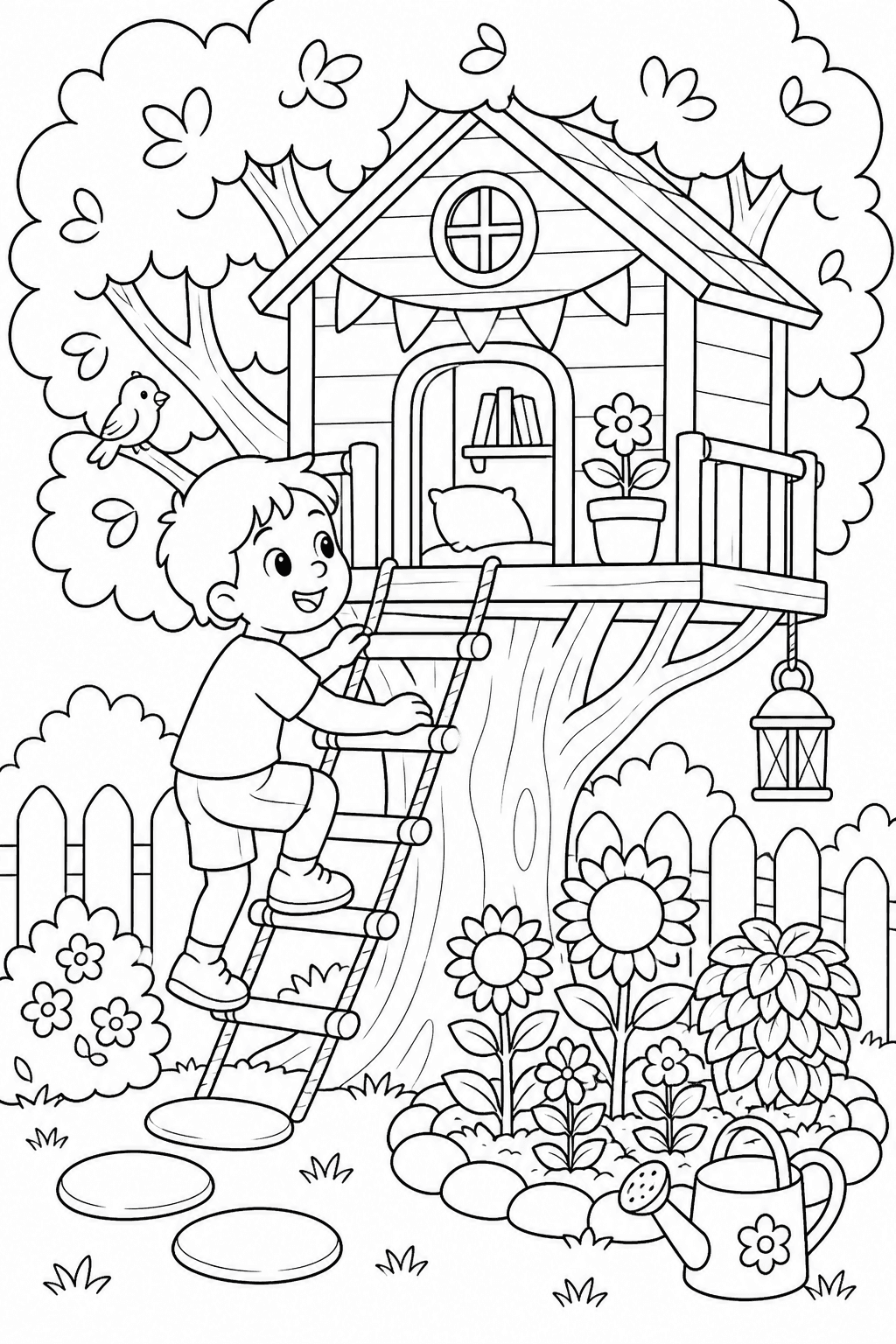
Coloring Page Prompts: How to Describe a Clear, Printable Scene
Updated 2026-10-25 · 7 min read
The examples below are original starting descriptions to adapt. Generated results vary; inspect each page before printing.
Useful coloring page prompts name one main subject, one action or setting, the intended detail level and the spaces you want to color. Write prompts for coloring pages as a short scene description, then check the generated outlines before printing. A reading corner with a cat, book and lamp is easier to direct than a long list of unrelated decorations.
On this page
The workflow in three decisions
- 01Describe what the picture shows before adding style words.
- 02Use detail and white space to match the activity, not an arbitrary prompt length.
- 03Check anatomy, important objects and coloring regions in the result.
Choose whether you need a scene prompt or a photo instruction
Use coloring page prompts in the Text tool when you want an imagined scene: a rabbit baking bread, a dog driving a toy train or a quiet garden table. Prompts for coloring pages work best when the generator has a clear subject and action to organize, rather than a collection of unrelated keywords.
Start with the photo-with-prompt workflow when a real pet, person or place matters. Upload the picture and describe the feature to retain. If the page's main purpose is a written name or word, use the word coloring tool; a scene description and a lettering layout solve different tasks.
Create a scene from a written description · Use a photo with preservation notes · Create a page centered on a name or word
Build coloring page prompts in five parts
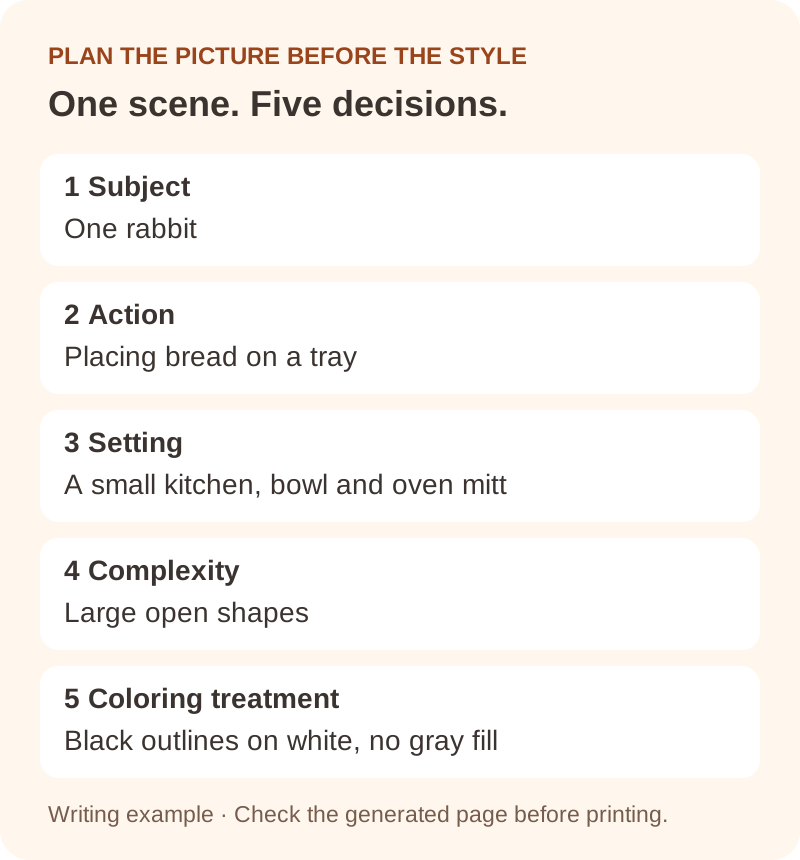
Build coloring page prompts from subject, action, setting, complexity and coloring treatment. For example, the subject is a rabbit, the action is placing bread on a tray, and the setting is a small kitchen. Prompts for coloring pages need only the objects that explain that moment; a bowl and oven mitt can say more than a wall full of decorations.
Add a practical direction such as large open shapes for a short children's activity or smaller patterned areas for a longer coloring session. In a general image tool, explicitly ask for black outlines on white and no gray fill. In a dedicated coloring-page tool, spend most of the description on the scene and use the available controls for its visual direction.
- Subject: one rabbit, a sleeping dog, a school garden or a family picnic.
- Action: reading, planting, sharing tea or putting bread on a tray.
- Setting: name one place and a few useful objects.
- Complexity: large simple areas or finer detail for a longer activity.
- Coloring treatment: clear outlines, white spaces and a safe page margin.
Four original prompts for different coloring activities
These coloring page prompts give each page one visible job. Change the subject, age guidance or setting to fit your activity. Treat prompts for coloring pages as directions to review, rather than promises of a particular finished picture; objects, spelling and anatomy can still need correction.
- First crayons: One cheerful turtle beside a large leaf, with broad shell sections and an otherwise open background. Simple black outlines, large white coloring areas and no shading.
- Quiet reading: A cat resting on a window seat beside an open book, small lamp and folded blanket. Show rain outside the window, with clear outlines and comfortable white spaces inside the room.
- Classroom observation: A child planting one seed in a pot, with a watering can beside the pot. Keep the seed, pot and hands distinct, use a simple background, and leave room to color each object.
- Longer coloring session: A small greenhouse worktable with one fern, seed trays, a watering can and a tiled floor. Include finer leaf and pot patterns while keeping separate white areas for coloring; no gray fill.
Try your own version in Text to Coloring Page · Browse Cozy scenes for visual ideas
Rewrite a crowded prompt by changing one decision
When coloring page prompts describe several places and activities at once, choose the scene's anchor before adding more style instructions. For clearer prompts for coloring pages, decide what the reader should notice first, then keep only the objects that support it. The examples compare wording, not tested image outputs.
| Starting description | More focused description | What changed |
|---|---|---|
| A magical cozy room with lots of animals, toys, books, plants and decorations everywhere. | One rabbit reading on a chair beside a window, with an open book, small lamp and one potted plant. Clear black outlines and open white areas. | One character and one action replace competing subjects. |
| A cute dinosaur coloring page, very detailed, for a toddler. | One friendly dinosaur holding a large balloon, with broad body shapes and almost no background detail. | The detail request now matches the simple activity. |
| A beautiful realistic shaded flower picture. | Three daisies in a single pot, with separate petals and broad leaves, black outlines on white and no shaded fill. | Specific objects and colorable regions replace a vague appearance. |
For a photo, say what must remain recognizable
Photo-based coloring page prompts should explain what matters in the uploaded image. If the family dog has one folded ear or a child is holding a favorite toy, name that feature and keep the rest of the request short. Prompts for coloring pages cannot recover a face that is too blurred or too small to see; choose a clearer original first.
Example instruction: Keep the dog's folded left ear, round collar tag and seated pose. Simplify the rug and wall into a calm background, with open white coloring areas. Compare the result with the photo; a preservation request does not guarantee every detail will stay unchanged.
Use the photo-with-prompt workflow · Follow the photo selection and printing tutorial
Review the result before you add more prompt words
Evaluate coloring page prompts by the picture they help you make. Can you identify the main subject, separate the objects and follow the boundaries with a crayon? Prompts for coloring pages should support that task. If the background is crowded, remove secondary objects; if the face is wrong, revisit the reference or simplify the subject instead of adding more decorative adjectives.
Check hands, paws, repeated objects and any requested letters. For a lesson, also verify quantities and the order of a process yourself. Match the detail to the person who will color: age labels are helpful starting points, not a substitute for looking at the page.
Save a useful prompt and print a test sheet
Once your coloring page prompts give you a useful direction, save the scene description and note the controls you chose. Reusing prompts for coloring pages can help you plan a related set, but it does not guarantee identical characters or linework across separate generations. Compare the pages side by side before treating them as a collection.
In Love to Color, the anonymous creation is one watermarked Standard 1K preview. Sign-in saves a project without unlocking it; use eligible credits for the unlocked creation download or print. Open the full downloaded PNG, fit it within your printer's A4 or US Letter printable area and test one sheet. Use the existing gallery if you need a ready-made page instead.
Check current creation credit options · Browse printable gallery line art
FAQ
What should I include in a coloring page prompt?
Include one subject, an action or setting, a few supporting objects and a suitable detail level in a coloring page prompt. Prompts for coloring pages should also describe usable coloring areas when that is important, such as broad shapes with white interiors. Review the result rather than assuming each instruction was followed.
Do longer coloring page prompts make better pages?
Longer coloring page prompts are useful only when the extra details resolve a real decision. Prompts for coloring pages become harder to direct when they contain conflicting complexity requests or several unrelated scenes. Remove one competing idea and check the next result.
Can I use these prompts in any image generator?
You can adapt these coloring page prompts to another tool's input and controls. They are original writing examples, not a cross-model performance test. Prompts for coloring pages may need different wording elsewhere, and file formats, access rules and available styles depend on that tool.
Will a prompt add a name correctly every time?
A coloring page prompt can request letters, but spelling and placement still need inspection. For a page centered on a name, use the word coloring tool and check the finished letters. Prompts for coloring pages about a scene should stay focused on that scene rather than relying on incidental lettering.