Familiar Everyday Colors
Start with the person, object or routine that gives the page its main action.
Help children make sense of familiar parts of the day with printable routine scenes. Start with a morning sequence, a simple picture schedule, a clothes-and-shoes step or quiet bedtime reading, then choose the age and difficulty that fit the activity.
Clear one filter or return to the full collection.
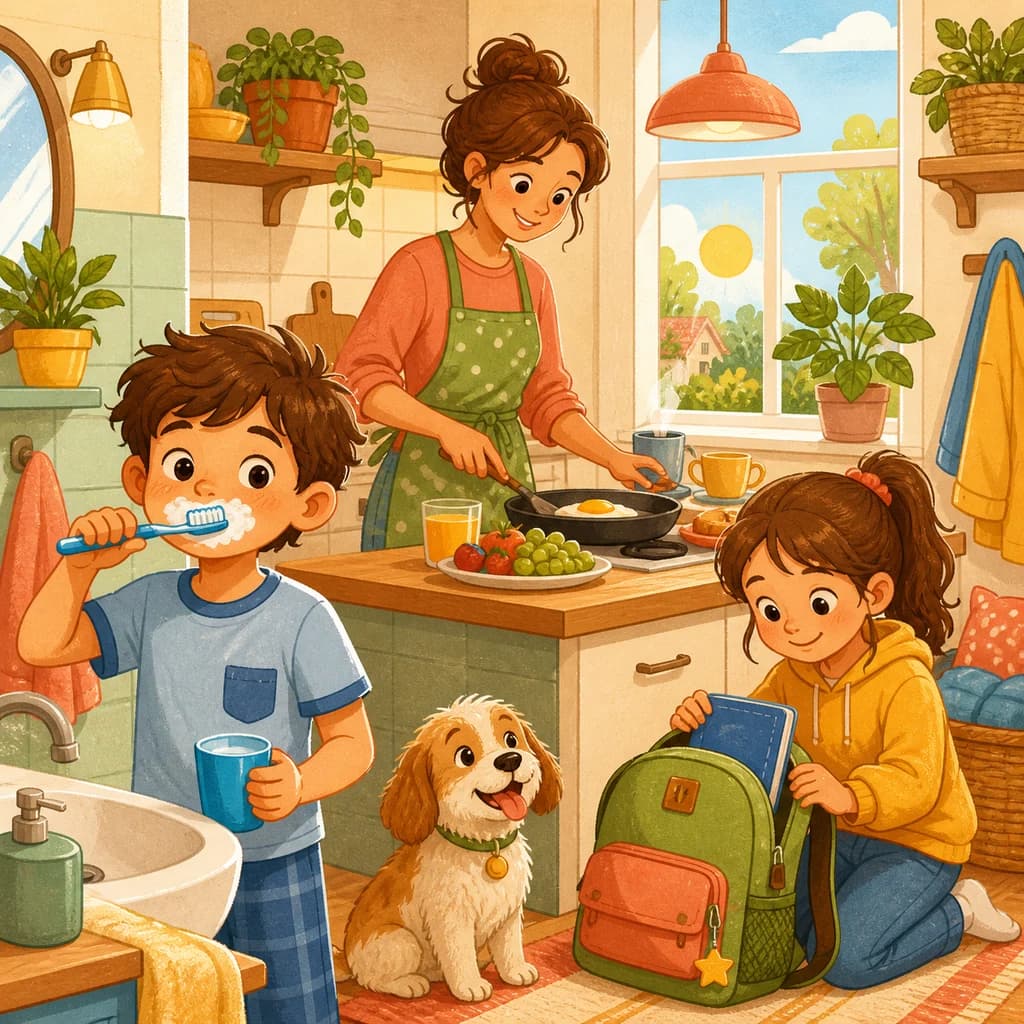
Show all pagesDaily routines become easier to discuss when children can see one small step at a time. The currently published pages in this collection show a breakfast preparation moment, a simple picture schedule near a bathroom brushing area, a three-action sequence at a clothes-and-shoes station and a quiet bedtime task beside a reading corner.
Parents, teachers and homeschool families can use these daily routine coloring pages as conversation starters rather than tests. Ask what happens before the pictured step, what comes next and which part the child already does independently. The scene stays open enough for children to add their own colors and details.
Choose the page by the amount of structure the child needs. A broad, easy scene works for a first routine conversation; a sequence or schedule can support early elementary learners; a calmer bedtime page gives older kids a quieter activity. Every published design is an individual PNG, not a bundled PDF set.
Preschool and kindergarten learners can begin with a simple, uncluttered routine moment. Early elementary children may enjoy a sequence or picture-schedule scene, while older kids can use the quieter bedtime page for a longer conversation about planning and independence.
The four currently published pages cover a breakfast preparation corner, a bathroom brushing-area schedule, a clothes-and-shoes sequence and a bedside reading routine. The page count is shown as a live fact; additional morning, self-care, school-preparation and bedtime scenes are planned separately and are not presented as available yet.
A routine is easier to understand when its clues are visible. A breakfast corner suggests a morning start, a picture schedule shows order without requiring text, and a clothes-and-shoes station connects preparation with leaving home. These details invite observation while leaving the child free to explain the routine in their own words.
Bedtime scenes work differently from morning scenes: the pace is quieter, the number of objects can be smaller and the focus may be on finishing one task before resting. Coloring gives families a low-pressure way to compare those rhythms without claiming that every child or household follows exactly the same schedule.
Open a published design to view the line art and download its individual high-resolution PNG. Print in portrait orientation on A4 or US Letter paper and choose Fit to printable area so the full routine scene stays inside the printer margins. Standard paper works for crayons and colored pencils; heavier paper is useful for markers.
Browse the daily routines collection and open the design that fits your coloring session.
Use the download action on the individual page to save its high-resolution PNG.
Print in portrait orientation on A4 or US Letter paper and choose Fit to printable area.
Use crayons, pencils or markers, then display the finished page or use it in your activity.
Use these practical palette ideas with crayons, colored pencils or markers.
Start with the person, object or routine that gives the page its main action.
Keep rooms, paths and background details lighter than the main subject.
Use a bright color for the object that helps explain the daily activity.
Once the coloring is done, use the finished page to continue the creative moment.
Ask the child to point to the first visible step, then describe what might happen before and after it.
Let children color repeated routine clues—clothes, a book, a cup or a schedule picture—in a consistent personal color code.
Use one page as a story prompt: who is nearby, what is ready, and what small task could be finished next?
Print one individual PNG for a quiet-time basket, a classroom life-skills station or a homeschool conversation.
Yes. Each published design can be opened and downloaded as an individual high-resolution PNG for personal, home, homeschool and classroom use.
The published set currently includes a breakfast preparation moment, a simple picture schedule, a clothes-and-shoes sequence and a quiet bedtime reading routine.
Start with the page marked Easy or with the fewest supporting objects. Broad, recognizable routine clues are usually easier for preschool and kindergarten learners to discuss and color.
Yes. Use an individual page for a life-skills conversation, a morning-meeting prompt, quiet work or a homeschool activity. The pages are open-ended and do not require a written worksheet.
Open the individual page, download the high-resolution PNG, choose portrait orientation, select A4 or US Letter paper and use Fit to printable area.
No bundled PDF schedule is currently offered. Each published routine design is downloaded separately as a high-resolution PNG.